
Okay, can we just take a second to appreciate spring in Maryland? The trails are back. The backyard doesn’t look like a crime scene anymore. Your dog is doing that full-body wiggle every time you touch the leash. Honestly, same energy.
But here’s the thing (and I say this as someone who spends every single day with dogs): spring is sneaky. While you’re enjoying the weather and your dog is losing their mind over every new smell, a whole set of hazards quietly shows up alongside the blooms. Most of them aren’t obvious. Most owners don’t find out about them until something goes wrong.
So consider this your heads-up before the season really gets going. Five things worth knowing before you and your pup head out.
1. That mulch your neighbor just laid down? It might be dangerous.
Cocoa mulch is everywhere in Maryland neighborhoods come spring, and it smells absolutely amazing. That’s exactly the problem. It’s made from cocoa bean shells, and it contains theobromine, the same stuff that makes chocolate toxic to dogs. A dog that sniffs around a freshly mulched garden bed and decides to take a little taste can end up with vomiting, muscle tremors, or something much worse.
And it’s not just the mulch. Fertilizers, weed killers, and especially slug bait (anything with metaldehyde in it) can be seriously dangerous, and some of them stay dangerous even after they’ve dried. The tricky part is your dog has no idea. To them it just smells like the ground.
Honestly, the most practical thing you can do here is two things: keep your dog on a leash near any yard that’s been recently worked on, and teach a rock-solid “leave it.” I cannot tell you how many times that one command has saved a dog from eating something awful. If your dog does get into landscaping products, don’t wait and see. Call your vet or the ASPCA Poison Control line (888-426-4435) right away.
2. Wild mushrooms are not your dog’s friend.
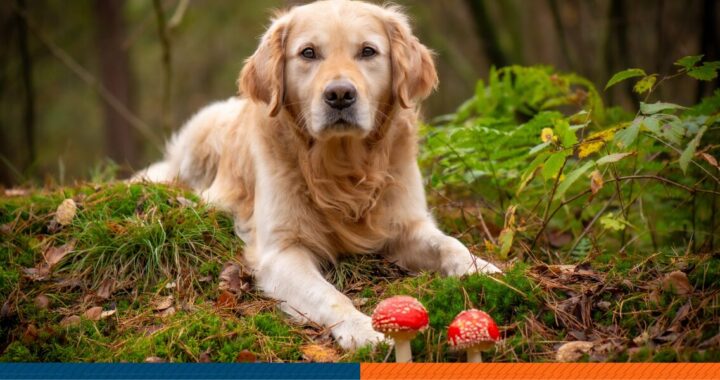
After a good Maryland rain, mushrooms pop up fast. Backyard, park trail, soccer field, you name it. And dogs, bless them, will eat a mushroom with zero hesitation if it smells remotely interesting.
The scary part is that some of the most toxic species in our region, like the death cap (Amanita phalloides), look completely unremarkable. Even people who study mushrooms professionally get them wrong sometimes. And with the really dangerous ones, symptoms don’t always show up for hours. By the time your dog seems sick, there’s already a lot happening internally.
I’m not trying to scare you. I’m just saying: after rain, do a quick sweep of your yard before you let your dog out to roam. On trails, keep them close. And if there’s even a chance they ate something mushroom-shaped, call your vet immediately and don’t wait for symptoms.
3. Spring wildlife is beautiful, until your dog chases it into traffic.
Baby season. Everything’s out. Deer, geese, groundhogs, foxes, raccoons, all of them more active, more visible, and honestly more aggressive than usual because they’re protecting their young. For a dog with any prey drive at all, this is basically a sensory carnival.
Here’s what worries us most: a dog that bolts after a deer doesn’t know there’s a road at the end of that field. A dog that corners a raccoon doesn’t know raccoons fight back. And a nesting goose near a Maryland waterway? Those things are genuinely unhinged in May. They will come for your dog and they will mean it.
There’s also the tick situation. People think tick season starts in summer. It doesn’t. In Maryland, deer ticks wake up as soon as it gets above 35°F, which around here can happen in February. If you’re walking through any tall grass or wooded area, check your dog when you get home. Every time. It takes about two minutes and it matters a lot.
The bigger picture here is recall. A dog that comes back when called, reliably, even when something exciting is happening, that’s a dog you can trust in spring. If that’s not where you are right now, it’s worth working on before the season really picks up.
4. The pavement is already hotter than you think.
This one catches people off guard every year. Most Maryland dog owners know to worry about hot pavement in August. What they don’t realize is that on a mild 75°F spring day (totally normal here by late April) the asphalt can hit 125°F or higher. Dog paw pads can burn in under a minute.
The signs aren’t always immediate. Sometimes it’s limping, sometimes it’s your dog obsessively licking their feet when you get home, sometimes it’s pads that look raw or start to peel a day later. Once you see it, you can’t unsee it.
Do the seven-second test: press the back of your hand flat on the pavement and hold it for seven seconds. If you pull away, your dog shouldn’t be walking on it. Simple rule, saves a lot of pain.
Morning and evening walks are the move once it gets warm. Stick to grass and shaded paths whenever you have the choice. And if your dog does burn their paws, do a cool water rinse, skip the ice, and call your vet.
5. Spring is escape season, and most people don’t realize it until their dog is gone.
This one doesn’t get talked about enough. Late April through June is genuinely the most common time of year for dogs to go missing, and it makes total sense when you think about it. Your dog has been cooped up all winter. Suddenly everything outside smells different, sounds different, and is a thousand times more exciting. Windows are open for the first time in months. The fence line is looking a lot more interesting.
Add in Maryland’s spring thunderstorm season (we get some real ones in May and June) and you’ve got dogs who are already overstimulated suddenly becoming anxious and unpredictable on top of it.
Worth taking twenty minutes this week to walk your fence line and look for anything winter may have shifted or loosened. Check that your window screens are actually secure, because dogs push through them more than you’d think. Make sure your dog’s microchip registration and tags are current. And if your dog has ever bolted before, take it seriously as a training issue rather than just a management one, because spring is when it tends to happen again.
The thing all five of these have in common
Every single one of these hazards is made significantly safer by one thing: a dog who listens to you when it counts. “Leave it” near the mulch. Coming when called near the wildlife. Staying calm on a walk instead of pulling toward the hot pavement. Not bolting the second the gate opens.
That’s not luck. That’s training, and it’s what we do every day at OLK9MD.
If you’ve been thinking about getting your dog some structured training, spring is genuinely a great time to start. The distractions are real, the stakes feel more concrete, and the payoff (a dog you can trust off-leash, anywhere) is worth every bit of the work.
Give us a call at 443-743-3221 or book a free phone consultation here. We’ll talk through where your dog is right now and what makes the most sense for you both.
Every dog is trainable. We mean that.